The new CMO playbook: how marketers are balancing broader remits and tighter budgets
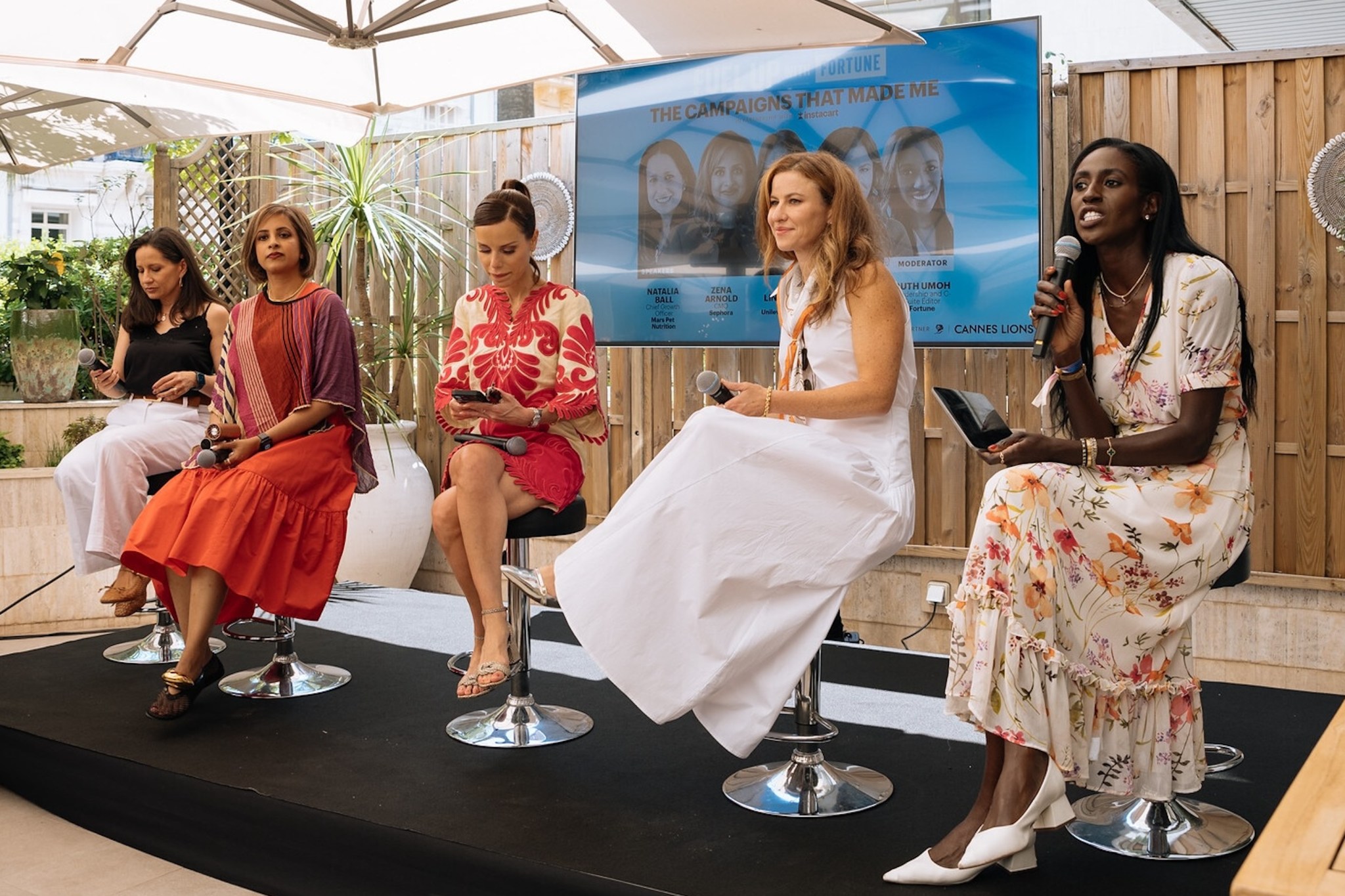
Marketing leaders at Cannes Lions discuss their expanding list of responsibilities, AI’s threat to creativity and the importance of having a CMO on the C-suite
Overview
A recurring theme on and off stage at Cannes Lions International Festival of Creativity this year was just how drastically the marketing job has changed. It’s no longer all about making great ads. Today’s marketing leaders are expected to understand AI, build communities, and shape organizational culture.
As marketing leaders have taken on broader responsibilities, budgets have remained flat. Across the U.S. and Europe, businesses allocated an average of 7.7% of company revenue to marketing in 2025—the same as in 2024 and down from 9.5% in 2022, according to Gartner’s 2025 Global CMO Spend Survey.
The representation of marketing heads in the C-suite is also declining. Less than half (49%) of Fortune 500 marketers held the “CMO” title in 2025, down from 55% a year earlier, according to research by Forrester.
Separate research by leadership consulting firm Spencer Stuart found that a third of Fortune 500 marketing leaders did not have the word “chief” in their title, 16% carried dual-function titles such as chief marketing and communications officer, and 11% had no reference to marketing.
UPS, for example, has grouped the leadership responsibilities for sales, marketing, and communications under the single role of chief commercial and strategy officer.
Last year, Reckitt, the multinational consumer-goods company, folded marketing and commercial strategy into a single function and gave regional teams more power to build the brands in their own markets.
Read more: Reddit COO targets 1 billion users as internet’s ‘odd duck’ aims for new heights
“This was an explicit attempt to break down silos and push brand-building power out to local markets,” Ryan Dullea, Reckitt’s chief growth officer, tells Fortune. “We need to stop running brand and commercial strategy as separate disciplines if marketing is to be viewed as a continuous business function.”
“The traditional CMO was a steward of creativity and communications, occasionally fluent in data, and perpetually at war with the CFO over budget”
However, Tim Ellis, executive vice president and CMO at the National Football League (NFL), believes marketing chiefs still need their own voice within the C-suite. “CMOs need to be at the table, listening and contributing to every decision the business makes,” he tells Fortune. “Yes, we have to be experts in the marketing world. But we also need to be experts in business. That requires completely new ways of thinking.”
The most effective way to communicate marketing’s value internally is through profitability and revenue growth, according to 46% of the marketing and finance decision-makers surveyed by Fortune, in partnership with Morning Consult.
“The traditional CMO was a steward of creativity and communications, occasionally fluent in data, and perpetually at war with the CFO over budget,” says Mélanie Brinbaum, Nestlé’s European head of marketing and consumer communications. “Today, the ones who can speak finance, supply chain and risk fluently are the ones who can prove where growth and value actually come from.”
Communication with data and technology teams has also taken on added importance for CMOs. “I used to need one language. Now I need several,” says Lynsey Woods, senior global brand director at Carlsberg. “I talk to finance, data, and tech daily. That’s not a soft skill anymore. The whole business is reorganizing itself around new technology and data, and marketing can’t sit in a corner and lob campaigns over the wall.”
Details
Keeping marketing’s creative edge
This added focus on financials can sometimes be at odds with the more creative aspects of marketing. Ellis admits that the creative instinct that defined his early career is no longer where the value sits. “Creativity still matters, but it’s not the center of the job anymore,” he says. “I’m expected to understand how brands move through culture and actually shape society, not just how to nail a clever campaign.”
However, Marcela Melero, chief growth officer for Dove in North America, remains adamant that marketing should not lose its creative edge. “The internal corporate environment can be a bit like a meat-grinding machine, where high-quality creative ideas get turned into a generic product by stakeholders with too many opinions,” she says.
Finding allies within the C-suite can be helpful when trying to get a creative idea approved. “Before I take a risky idea forward, I look for at least one other person in the C-suite who believes in it,” Melero says. “There was a project my Argentine team was convinced would kill the brand, but it worked. Once you have one of those on the board, the next risk is easier to sell.”
“Our job is also to make sure we don’t manage the business purely through a scorecard or a P&L,” Brinbaum says. “Marketing leaders today have to create conditions where people feel safe enough to give direct feedback, take risks and think slowly when everything around them is moving fast.”
Adapting to AI
AI is also placing some of marketing’s creative roles at risk. A third (34%) expect AI to replace some creative functions, and 19% think it could significantly reduce the need for human creativity altogether, the Fortune and Morning Consult survey found.
“The spirit of marketing hasn’t moved—you find an audience and persuade them—but the how has been utterly rebuilt around generative and agentic AI,” says Dullea. At Reckitt, internal AI tools now surface insights and ideas in roughly a third of the time once required.
Sephora US CMO Zena Srivatsa Arnold warns against “surrendering” to the technology. “Marketers can use AI to inform them but must maintain their own conviction,” she says.
For Andrew Warden, vice president of marketing at Adobe, agentic AI represents the “single biggest shift in marketing in 25 years”. “It’s changing not just how marketing works but who, or what, brands are talking to. We didn’t expect bot traffic to overtake human traffic so quickly,” he adds. “CMOs need to stay focused on marketing to humans, but also to AI agents.”
For Warden, this represents a “huge challenge”. The most successful CMOs will have to adapt to these challenges and their expanded brief, while continuing to communicate marketing’s value to the business.
Stay up to date with our on-the-ground coverage from Cannes.
This story was originally featured on Fortune.com
Source
Originally published at fortune.com.