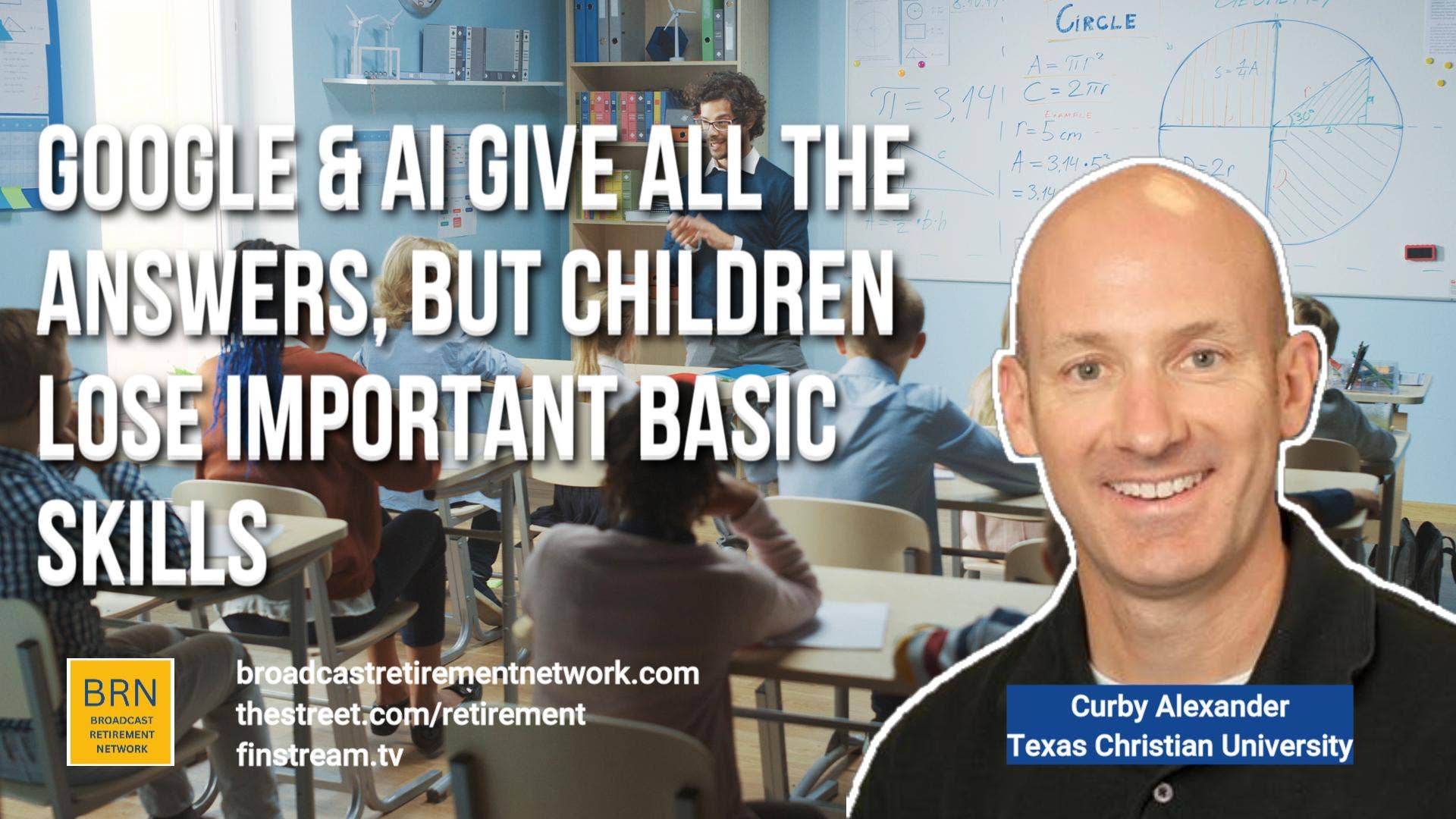
Google & AI Give All the Answers, but Children Lose Important Basic Skills
Modern digital technology is reshaping our world, but it is also quietly eroding the most fundamental life skills in our children. In this thought-provoking interview, former educator and parenting expert Curby Alexander of Texas Christian University joins the program to break down the unseen ...
Overview
Modern digital technology is reshaping our world, but it is also quietly eroding the most fundamental life skills in our children. In this thought-provoking interview, former educator and parenting expert Curby Alexander of Texas Christian University joins the program to break down the unseen consequences of our uncritical adoption of technology.
Jeffrey Snyder, Broadcast Retirement Network
Well, Curby, it is so great to see you. Thanks for joining us on the program this morning.
Curby Alexander, Texas Christian University
Yeah, thank you so much for having me.
Jeffrey Snyder, Broadcast Retirement Network
You know, I grew up many decades ago, Curby, and as a young man, I learned how to type on a typewriter. I used a fax machine, and I used a very early version of a personal computer. So I had the luxury of kind of more analog.
And this is, by the way, I didn't even have a digital clock as a young man. But the world has shifted, and everyone carries a phone, especially younger kids. How does today's world impact the ability of children to get the most important life skills, like reading a clock?
Curby Alexander, Texas Christian University
Well, you know, I think just the fact that there's so much digital technology out there, like you said, phones, and those phones that we carry around perform so many of the functions that we used to have different tools for. I mean, you think on your phone, you get your news, you get your weather. That's where you have your calendar.
It's how we communicate with people. It's our clock, not just an alarm clock, but a timer. So yeah, it's a lot different.
My upbringing sounds very similar to yours, where it seems like everything we had to do required kind of a different skillset, a different set of tools. And now it just seems like we have more and more digital tools that do things for us. I don't have to carry around a day planner and continually check it to make sure when I have meetings, because now my phone is just pushing out reminders when I have meetings.
So yeah, like my own kids, the world they've grown up in is a lot different, just because technology that's being developed, especially that's on their phones is doing a lot of stuff for them.
Jeffrey Snyder, Broadcast Retirement Network
How does this shape? Is there a concern that kids today, I just actually saw my niece and nephew who are younger, they're in their, I think they're nine and 13 or 10 and 13 respectively. Their life is in the digital world, but they go to school and they'll probably go to university.
But are there skills that these children, our children don't no longer have that we need to add back to the curriculum in schools like college and high school and junior high school?
Curby Alexander, Texas Christian University
Personally, I think there are some things that we should put back into the curriculum. I used to be a fourth grade teacher. That was my first job out of college.
I was a school teacher for quite a long time. And one of the things I taught was cursive handwriting, which now for the most part is disappearing from schools. And I know that there are probably some states that wanna bring it back.
And I just remember for myself, when I was writing things by hand, it did kind of like force me to slow down. So my brain seemed to work differently than when I'm typing. I can type pretty fast.
So I can type things, I can delete, I can revise. Whereas, I just remember with cursive writing, I remember having to slow down and my own students, having to slow down and be thoughtful. And I tell them at the very least, you wanna think about what you're writing as you're writing it, because you probably don't wanna have to erase a whole page or a sentence and go back and write it again.
And so, I think with technology, there's a saying that says, with every new innovation, it gives us something new and it takes something away. And I think that's something people should ask themselves about new innovations that come along. You know, by and large, I think our society is pretty uncritical when it comes to adopting new technologies.
We see things for their efficiency, for their speed, for their ease of use, but we don't always think about what it might be taking away. You know, I remember learning how to use a map and then eventually learning how to drive. And, you know, I didn't have a GPS.
So even though I'd grown up in my small hometown, you know, I would sometimes get lost because sitting in the car, I didn't always pay attention to landmarks that I did when I was driving. Well, now, you know, when my own kids learn to drive, sometimes, you know, there are landmarks that they have never really paid attention to until they finally turn off the GPS because they've just kind of been getting instructions turn by turn and not paying attention to not just names of streets, but landmarks and things that they see. And so I think any new innovation is going to give us some advantage maybe, whether that's efficiency or speed or ease of use, but it's gonna take something away.
You know, whether that's critical thinking, whether that's problem solving, whether that's being more aware of your surroundings. So yeah, for sure. I mean, I don't know what skills maybe need to be reintroduced to school curriculum, but I know that some of the things that have disappeared, even though it seems like maybe they've disappeared because they're obsolete, that means that other habits of mind, other ways of thinking, other ways of seeing the world, those have also disappeared when those skills have not been used in schools.
Jeffrey Snyder, Broadcast Retirement Network
Let me, you brought up critical thinking. This is something that I was immediately thinking of. When I was, I used to have to write papers.
Like I said, I started on a typewriter. Actually, I started in a notebook writing drafts. And I wrote them, by the way, in cursive.
Then I progressed to the typewriter. Then I moved on to the Apple IIe or Apple IIc as I'm dating myself. But through that process, my critical thinking evolved.
And I still apply that critical thinking. How can we, based on using technology today, how can we kind of bring that back? Because I think that maybe, and you're probably the best person to talk about it depending on both of us, is I think that that's something that's certainly lacking.
What does something really mean? How do you discern the truth or misinformation from fact?
Curby Alexander, Texas Christian University
Details
Yeah, I mean, that's a really great question. There are two things that have happened in the last, we'll say 20 years. Maybe it has been developing longer than that.
But it's just this explosion of information. The first was when the internet became something that basically everybody had access to. There was almost immediately this propensity by people to look something up.
At first, with like Yahoo and Ask Jeeves and some of those old search engines, you had to actually know keywords and kind of click links until you found the thing you were looking for. Google comes along and all you have to do is type in natural language. And it has a way of kind of finding the thing that you're looking for or approximating what it thinks you're looking for.
And almost instantly, people start, just using the first or second result that comes up in their search. I mean, there's all this data to support, even in schools, out of schools, wherever it is, that if somebody Google something, they're likely to go with the first result that comes up. It used to be on Google at the bottom of the page, you could see all the O's and those were all the pages that had the search results.
But people didn't really click those, right? They would just go with kind of the first couple of results. And it's the same with, like now we have generative AI, where it's not, you ask it something and not only does it, it doesn't even just find you a website that gives you the information you want, it just writes it for you.
And so what I think we're gonna see is a shift, maybe not among everybody, but I believe you're gonna start to see a shift among some schools, some educators, some parents, where they want to focus, put the focus back on the process of thinking through questions. Whether they're developing their own inquiry question or their own research question, or whatever it is that they're writing about. And you're gonna see people becoming intentional about not using some of these tools that just give us the information.
Because I remember kind of like you, I would write research papers and I would go into the library and I would have to look up books and articles and then I would have to check those things out and read them and find, to see if it even matches what I'm trying to do. And in the process of that, I was having to be discerning. I was having to continually research and think back on what is the point of this paper that I'm writing?
What is my thesis statement? What's my hypothesis? Is this research that I'm finding supporting that?
And so I was continually kind of doing this cyclical way of thinking where I was thinking about the argument I wanted to build and whether or not the stuff I was finding was evidence. And now, the technology just gives us the information and it's authoritative enough that in many cases, people don't even question whether it's true or accurate or not because it sounds good. And they think, well, this sounds pretty good to me.
And so honestly, I think that's a major outcome of education that could be at risk if schools are not intentional about focusing on the process of thinking, the process of doing research and finding evidence versus just letting the technology that's out there write the answers for them.
Jeffrey Snyder, Broadcast Retirement Network
Two words, card catalog. That's how I remember the card catalog. Remember, you would look it up?
Curby Alexander, Texas Christian University
Oh, yeah.
Jeffrey Snyder, Broadcast Retirement Network
Go through. Let me ask you. I could talk to you and we'll bring you back, but I wanna ask you about kind of finding our way back because we need, I think in successive generations, we're always seeing them get better, they're stronger, they're taller, they're bigger, hopefully they're healthier, right?
I mean, but this is an area of, in my mind, deficiency. How do we, who will lead this way back? Is it the parents, us back?
Is it the parents? Is it the educators? Is it the policymakers?
Is it a combination of all three? How do we work our way back to getting that level of critical thinking so that not only are you stronger and better as a human being, but also you're a major contributor to the future of human society? That's kind of very philosophical and high level.
I don't mean it sound that way, but in your mind, how do we find our way back?
Curby Alexander, Texas Christian University
You know, that's a great question. I think if I had a authoritative answer, there would be a lot of people that would wanna know where I got that information. It's my opinion, as someone who has raised kids and been a teacher that I think where we find our way back is in families with parents who are intentional about certain things, with teachers who are intentional about certain things.
You know, I know that there's a lot of, at least in the state where I live in, there's a lot of kind of top-down education policy being discussed right now. But the truth is, you know, the thing that is the most impactful is what the teacher does. And so teachers, I think, can be intentional about helping kids kind of find their way back to some of those baseline skills that may disappear, and families can as well.
You know, my two boys were involved in scouts, and this is not a commercial for Scouting America, but they gained a lot from it, because it is very traditional. I mean, there were a lot of opportunities for them to learn some of those things, but that was a choice we had to make. And trust me, along the way, I mean, there was a lot of pushback.
They were like, you know, because a lot of their friends didn't do it, or, you know, they had other things they wanted to do. But in the process of doing that, they learned a lot of these kind of older, traditional baseline skills that otherwise may have disappeared, like learning how to, you know, orient a map and use a map in the back country, or, you know, how to cook over a campfire, you know, and how to shop using ingredients, not just shop with, you know, buying pre-prepared food and things like that. Although I know there's a lot of power in policy makers, that states have a lot of power, school districts hold a lot of influence over what happens, I honestly think it's going to be individuals that kind of decide to take up those initiatives on their own, and they have the patience and the motivation and the conviction to follow through with it.
Jeffrey Snyder, Broadcast Retirement Network
Yeah, well said. I tend to agree. I think it's going to come from the teachers, the educators, and also the parents that kind of reinforce that.
Curby Alexander, we're going to have to leave it there. It's so great to see you. Thanks for joining us.
Thanks for sharing some insight, and we look forward to having you back on the program again very soon.
Curby Alexander, Texas Christian University
I'm looking forward to it. Thank you so much.
Source
Originally published at www.thestreet.com.
